

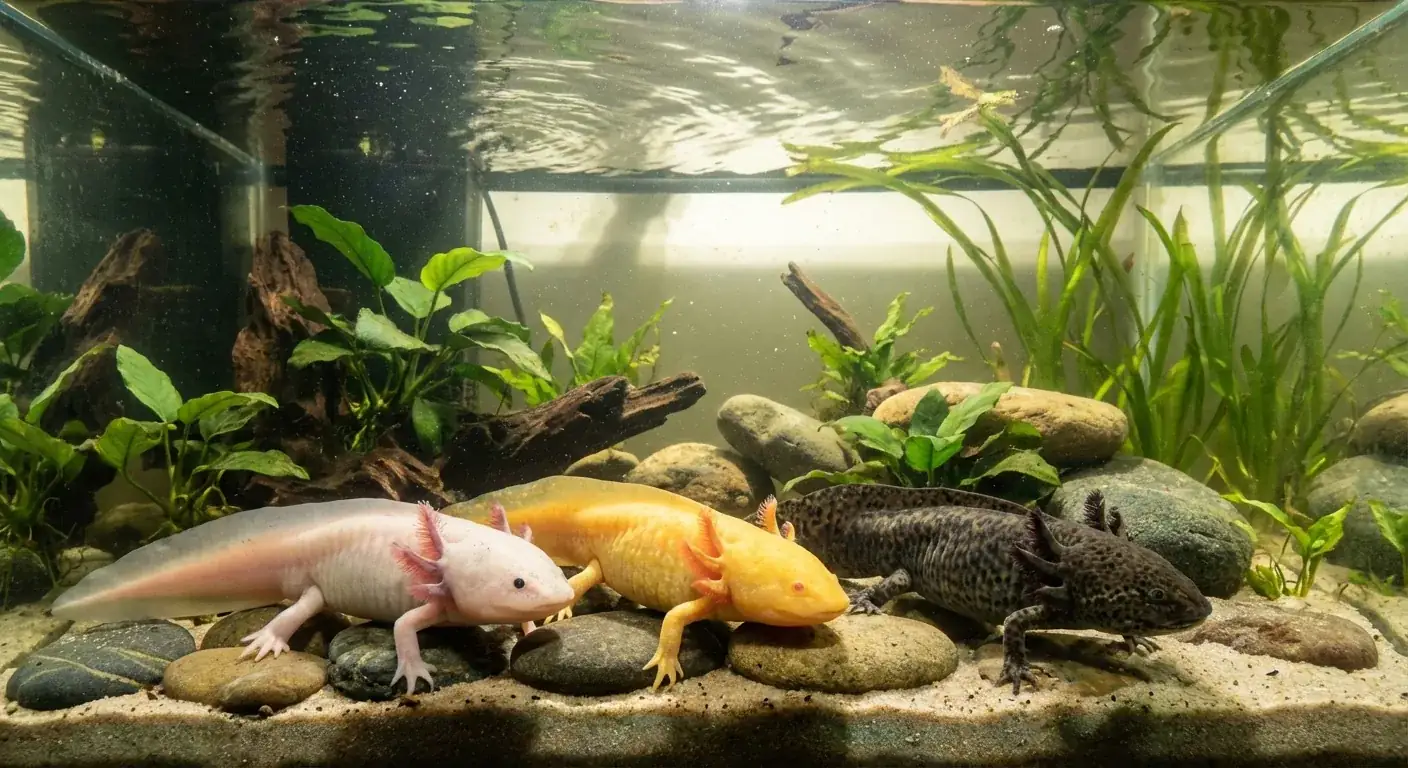
Axolotl color is inherited through ordinary gene rules. Each animal carries two copies of every color gene, one from each parent, and most color genes are recessive, meaning a trait shows only when both copies match. A capital letter marks the dominant working version and a lowercase pair marks the recessive form. Punnett squares predict the odds for each clutch.
How does inheritance work in axolotls?
Axolotls inherit color the same way most animals inherit traits: through paired genes passed down one copy from each parent. They carry 14 pairs of chromosomes, 28 in total, and each gene sits at a fixed spot on a chromosome. Because the copies come in pairs, every animal holds two versions of each color gene, and which two it holds decides both what it looks like and what it can pass on.
A gene can come in different versions, and each version is called an allele. For color genes, breeders write the dominant working allele as a capital letter and the recessive changed allele as the matching lowercase letter (source: axolotl.org genetics database). When an axolotl makes eggs or sperm, its paired alleles separate so that each cell carries only one copy. This splitting is called segregation, and it is the reason a single pairing can produce a mix of offspring rather than identical young. Each parent contributes one random allele per gene, and the two combine in the embryo.
Segregation also explains why color is unpredictable in a way that size or temperament is not. Most husbandry traits are shaped by many genes and the environment together, but the classic axolotl colors each turn on a single gene, so they follow clean, countable odds. That single-gene behavior is what makes a Punnett square useful here. The laboratory population that anchors most of what we know about these genes traces to a small founding stock studied for over a century at the University of Kentucky (source: Ambystoma Genetic Stock Center), and the standardized gene symbols keepers use today come straight out of that research record (per Ambystoma Genetic Stock Center). The axolotl care guide covers the husbandry framework these genetics notes sit inside.
What is the difference between genotype and phenotype?
Genotype is the set of genes an animal actually carries. Phenotype is what you can see, the color and pattern on the body. The two are not the same, because a recessive gene can hide. An axolotl with one working copy and one recessive copy of a color gene looks normal but secretly carries the recessive version, ready to pass it on.
This gap between carried and visible is the single most useful idea in axolotl genetics. An animal that carries two identical alleles at a gene is homozygous; one that carries two different alleles is heterozygous, often shortened to “het.” A heterozygous animal shows the dominant trait but still holds one hidden recessive copy. That hidden copy is exactly why two normal-looking parents can produce a surprise morph in their clutch. In my own tanks I once paired two wild-type-looking adults and got a scatter of albino young, because both parents were quietly carrying a recessive albino allele I could not see on their bodies. The genotype-to-phenotype table below maps the common allele pairs to what they produce and what they secretly carry.
| Genotype (allele pair) | What you see (phenotype) | What it can pass on |
|---|---|---|
| D/D (two dominant dark) | Normal dark pigment | Only the dominant dark allele |
| D/d (one dark, one recessive) | Normal dark pigment, looks the same as D/D | Dark or the hidden leucistic allele, 50/50 |
| d/d (two recessive) | Leucistic, pale body with dark eyes | Only the recessive leucistic allele |
| A/a (carrier of albino) | Normal pigment, hides albino | Working allele or hidden albino, 50/50 |
| a/a (two recessive albino) | Albino, no dark pigment, pink eyes | Only the recessive albino allele |
Reading genotype as separate from phenotype is what lets a keeper predict a clutch instead of guessing. Two leucistics look identical on the body, yet one might also carry albino while the other carries melanoid, so their young can show traits neither parent displays. The named-morph identification details, the body and eye tells that sort one look from another, live in the axolotl colors and morphs guide. This article stays on the inheritance mechanism behind those looks.
Which color genes are dominant and which are recessive?
Five color genes plus one added transgene account for nearly every axolotl you will meet, and almost all of the color genes are recessive. Recessive means the trait appears only when an animal carries two copies. The dark gene works in reverse, since its dominant form is the normal one and its recessive form produces leucistic. GFP is the lone dominant trait, showing up with just one copy.
The practical roster is short. The dark locus (d) controls whether pigment cells spread across the body; two recessive copies give a pale, dark-eyed leucistic. The albino locus (a) blocks the dark pigment eumelanin; two recessive copies give pink-eyed albinos. The melanoid locus (m) was mapped in 2023 to the leukocyte tyrosine kinase gene, and the study confirmed melanoid is recessive, since only embryos that inherited two copies showed the matte dark melanoid look (source: Kabangu et al. 2023, Genes). The axanthic locus (ax) removes yellow and reflective cells; the copper gene (c) is a form of albinism that makes a red-brown pigment instead of black. GFP, the green fluorescent protein gene borrowed from a jellyfish for research, is dominant and glows under blue or UV light. The inheritance table below sorts each gene by its pattern and what the recessive form does.
| Color gene | Notation | Inheritance pattern | What the recessive (or special) form does |
|---|---|---|---|
| Dark | D / d | Recessive trait (d/d) | Two d copies give leucistic; blocks pigment-cell spread |
| Albino | A / a | Recessive (a/a) | Blocks eumelanin; gives pink or red eyes |
| Melanoid | M / m | Recessive (m/m) | Matte dark, no shiny eye ring; mapped to the Ltk gene |
| Axanthic | Ax / ax | Recessive (ax/ax) | Removes yellow and reflective cells, leaving cool grey |
| Copper | C / c | Recessive (c/c) | Makes red-brown pheomelanin instead of black |
| GFP | G / g | Dominant (one copy shows) | Fluoresces green under blue or UV light |
The reason this roster matters for prediction is that recessive genes travel silently. A keeper can hold a line of normal-looking animals that all carry a hidden recessive, and the trait only surfaces when two carriers meet. The genetics database that tracks these standard symbols across the hobby is maintained by axolotl.org (per axolotl.org genetics database), and several of these genes interact, which is how a combined look like a white albino arises from two separate recessive genes pairing up at once. Because GFP is dominant, a single GFP parent can pass the glow to roughly half its clutch regardless of base color; the axolotl breeding guide covers how a dominant trait like this moves through a pairing.
How do you use a Punnett square to predict axolotl offspring?
A Punnett square is a simple grid that predicts the odds of each offspring type from a known pairing. You put one parent’s two alleles across the top, the other parent’s two alleles down the side, then fill each box with the pair that meets there. The four boxes show the genotype ratio, and counting which boxes match the recessive form gives the share that will show the trait.
Start with the most common breeder question: two normal-looking animals that both carry one hidden recessive albino allele, written A/a each. This is a heterozygous-by-heterozygous cross, and it is the classic case that produces a visible surprise. Across the top go the first parent’s alleles, A and a; down the side go the second parent’s, A and a.
The four boxes read one A/A, two A/a, and one a/a, a genotype ratio of 1:2:1. Only the a/a box shows the albino look, so on average one in four young, or 25 percent, will be albino. The other three look normal, but two of them quietly carry the albino allele. This 3:1 normal-to-albino phenotype ratio is the signature of a het-by-het pairing for any recessive axolotl color gene, not just albino.
Now take a het carrier paired with an animal that already shows the trait, such as A/a crossed with a true a/a albino. This is the cross many keepers use to “prove out” a suspected carrier.
Here two boxes are a/a and two are A/a, a clean 1:1 split, so about half the clutch will be albino and half will be normal-looking carriers. The third common case is the simplest: two animals that both show a recessive trait, a/a by a/a, can only produce a/a young, so every offspring shows the trait. When you track two genes at once, such as albino and melanoid together, the independent odds multiply, and a full het-by-het dihybrid cross produces the familiar 9:3:3:1 spread of combined looks. Real clutches run from one hundred to well over a thousand eggs, so these ratios show up clearly across a single spawning. Any pairing decision should weigh welfare first, and a new breeder should consult an experienced breeder or an exotic-animal veterinarian before committing; the axolotl breeding setup guide covers the tank side, and the axolotl cannibalism prevention guide covers raising that flood of larvae safely to rehoming size.
What does “het” mean, and can you read genotype from looks?
“Het” is short for heterozygous, an animal that carries one hidden recessive copy of a gene while showing the normal dominant look. On a breeder listing, “het albino” means the animal is visually normal but proven or expected to carry albino. The label predicts what the animal can pass on, since you cannot read a hidden recessive gene from the body alone.
Breeder listings use a few standard phrases, and reading them correctly changes what a clutch can produce. The decoder table below translates the common ones.
| Listing language | What it means | Practical takeaway |
|---|---|---|
| 100% het albino | Confirmed to carry one albino allele | Will pass albino to about half its young |
| 50% possible het | One parent carried it; this animal may or may not | Carrier status unproven until test-crossed |
| Visual albino | Shows the trait, genotype a/a | Passes an albino allele to every offspring |
| Double het | Carries hidden recessives at two genes | Can throw two surprise traits at once |
The honest limit is that a hidden recessive leaves no visible mark, so a normal-looking axolotl could carry albino, melanoid, or nothing extra, and no photo will tell you which. The standard gene symbols and the het notation that breeders trade in are tracked in the axolotl.org genetics database (per axolotl.org genetics database), which is why a careful listing names the exact gene rather than a vague “may carry something.” Breeders confirm a carrier through a test cross, pairing the suspect against an animal that shows the trait and watching whether any affected young appear. A reliable test cross needs a decent number of offspring, because a small clutch can miss the trait by chance and give a false all-clear. One affected baby is enough to prove a carrier, but a run of normal young never fully rules a recessive out, only lowers the odds it is there. This is also why pedigree paperwork matters more than appearance when you buy breeding stock; the healthy-axolotl selection guide covers screening an animal regardless of its genotype, and the axolotl gendering and separation guide covers sorting animals before any pairing.
Why does genetic diversity matter for captive axolotls?
The captive axolotl descends from a very small founding stock, which makes the pet and laboratory population unusually inbred. Roughly 34 animals were shipped to Paris in 1863, and nearly every captive axolotl traces back to that narrow base. Low diversity raises the odds that harmful recessive genes pair up, so diversity is a real welfare concern, not just a breeder’s technicality.
The numbers behind this are striking. The long-running laboratory colony carries an average inbreeding coefficient near 35 percent, far above the 12.5 percent level that conservation managers treat as an emergency for an at-risk population (source: Voss, Woodcock and Zambrano 2015, BioScience). The inbreeding coefficient is just a measure of how likely an animal’s two copies of a gene are to be identical by descent, so a high figure means a line has been folding back on its own relatives for generations. That history left the species with reduced genetic variation, and the captive stock even carries a measurable stretch of tiger salamander DNA introduced through a historical cross (source: Woodcock and Voss 2017, Scientific Reports). High inbreeding does not doom an individual animal, but across a line it can surface inbreeding depression, the buildup of problems that appear when too many shared recessive genes line up. Watch for warning signs over generations.
- Smaller clutch sizes or more unfertilized eggs than a healthy pairing should give.
- Higher rates of deformity or early larval death in the clutch.
- Slower growth or weaker feeding response compared with outcrossed siblings.
- Shorter working lifespan or reduced fertility in the breeding adults.
None of this means a keeper should avoid the species. Pet axolotls live full lives with good husbandry, and the wild population is a separate conservation matter, since the species is critically endangered in its native Xochimilco canals while the pet line is genetically distinct (conservation status per Conservation International). The point is that anyone choosing to breed should treat diversity as part of animal welfare. The axolotls as pets overview covers the long commitment behind that choice.
How should keepers make responsible genetic decisions?
Responsible genetic decisions come down to four habits: track lineage, outcross when you can, never pair for looks alone, and lean on people who know the lines. Good records let you avoid mating close relatives, and bringing in unrelated stock widens the gene pool. Choosing pairs for health and diversity rather than rarity protects both the animals and the hobby.
The checklist below turns those habits into a practical routine for anyone weighing a pairing.
| Decision step | What to do | Why it matters |
|---|---|---|
| Track lineage | Keep written records of each animal’s parents and morphs | Prevents accidental sibling or parent-offspring pairings |
| Outcross when possible | Bring in unrelated stock from a different line | Widens the gene pool and lowers inbreeding risk |
| Avoid pairing on looks alone | Weigh health and history, not just color or rarity | Selecting hard for one trait narrows diversity fast |
| Confirm before committing | Test-cross suspected carriers; ask experienced breeders | Reduces surprise clutches and stacked health problems |
| Plan for the whole clutch | Line up homes for ordinary young, not just standouts | A clutch of hundreds all need 10 to 15 year homes |
The welfare framing is the part new breeders most often skip. A pairing is a commitment to every animal it produces, and a single clutch can run from a hundred to well over a thousand eggs, so the responsible question is not only “what colors will I get” but “can I care for all of them.” When a pairing involves a known carrier line or any health uncertainty, consult an experienced breeder or an exotic-animal veterinarian before proceeding. Light-sensitive morphs like albinos also need the right setup once they hatch, which the axolotl lighting guide covers, and the axolotl egg care guide covers handling the eggs through hatching. Tracking how those young develop afterward sits in the axolotl size and growth guide.
Frequently asked questions
Can I tell an axolotl’s full genotype just by looking at it?
No. You can read the visible traits, so an albino is clearly a/a at the albino gene, but you cannot see hidden recessive copies at other genes. A normal-looking wild type might carry albino, melanoid, or nothing extra, and the body gives no clue. The only ways to know a carrier status are reliable pedigree records or a test cross that pairs the animal against one showing the trait and counts how many affected young appear.
What happens if I cross two different morphs together?
The result depends on which genes each parent carries, not just on the morphs you see. If both parents are homozygous recessive at different genes, the first generation usually looks wild type while quietly carrying both recessives as double hets. Pair those offspring later and you can get combined morphs that neither original parent showed. This is how breeders build stacked-gene looks, accepting that only a fraction of each clutch hits the target combination.
How many babies do I need to confirm a suspected carrier?
More than a handful, because chance can hide a recessive in a small group. If a het-by-affected test cross should give about half affected young, a clutch of only a few eggs might show none purely by luck, giving a false all-clear. Larger clutches make the result trustworthy, since the expected ratio shows up more reliably as numbers climb. Axolotl clutches are large, often hundreds of eggs, so a single well-tracked spawning usually settles the question.
Are pet-store axolotls more inbred than breeder axolotls?
Not necessarily, since the whole captive population shares the same narrow founding stock and carries high baseline inbreeding. What varies is record-keeping. A careful breeder who tracks lineage and outcrosses can keep a line healthier than an unmanaged source, whether that source is a store or a hobbyist. The useful question is not store versus breeder but whether anyone documented the animal’s parents and avoided pairing close relatives.
Does the GFP gene change how color genes are inherited?
No. GFP is a separate dominant gene that adds a green glow under blue or UV light, and it sits on top of whatever base color genes the animal carries. It follows its own inheritance, so one GFP parent passes the glow to roughly half its young, while the albino, melanoid, and other color genes segregate on their own schedule. A GFP albino, for example, inherits the glow and the albino look through two independent genetic channels.
Why did two leucistic parents give me young that are not all leucistic?
If every offspring is leucistic, both parents were homozygous leucistic at the dark gene, which is the usual outcome. If some young differ, the surprise is at other genes rather than the dark gene. Two leucistics can each carry hidden recessives like albino or melanoid, and when those carriers pair, a share of the clutch shows the second trait stacked onto the leucistic base, producing looks neither parent displayed.
Related guides
By the ExoPetGuides editorial team (AI-assisted drafting; human-reviewed), reviewed by an exotic-animal veterinarian
Updated 2026-06-02
Primary sources: axolotl.org genetics database, Ambystoma Genetic Stock Center (University of Kentucky), Voss, Woodcock and Zambrano 2015 (BioScience), Kabangu et al. 2023 (Genes)
Disclaimer: This content is for educational purposes only and is not a substitute for professional veterinary advice. Always consult a qualified veterinarian, ideally an exotic-animal specialist, for any health concern about your pet. Care recommendations may vary based on species, individual animal, and local regulations.
