

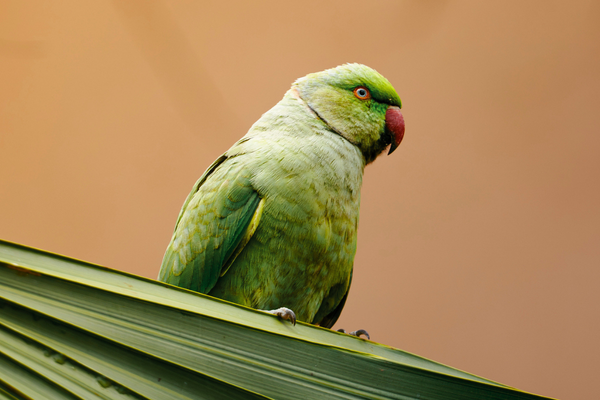
The Indian Ringneck is native to the Indian subcontinent and Sri Lanka (with the African subspecies found across sub-Saharan Africa and the Nile Valley). In its natural range it inhabits a remarkably broad spectrum of environments — open forest, woodland, farmland, urban parks, gardens and scrubland — and is one of the most adaptable and successful parrot species in the world. Established feral populations from escaped and released captive birds exist in the United Kingdom, the Netherlands, Belgium, Germany, the Middle East, Australia and numerous other countries.
In Australia, Indian Ringnecks are exotic (non-native) birds and are not subject to specific keeper licence requirements in most states, though a general biosecurity obligation applies as with all exotic birds. Sexual dimorphism — the pink and black neck ring — develops in males at approximately 18–24 months of age, making sex determination of young birds difficult without DNA or endoscopic sexing.
Indian Ringnecks are known for going through a ‘bluffing’ phase between approximately six months and two years of age, during which they may become nippy, defensive and less interested in handling — this is a well-known and entirely normal developmental phase that passes with consistent, patient management.
