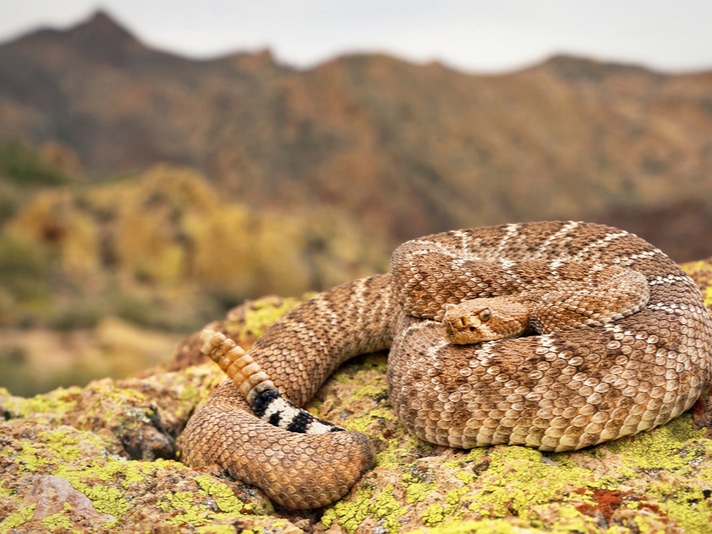
Scientists at the University of Maryland have found that the western diamondback rattlesnake is immune to its own venom. This discovery may lead to a new way of treating venomous snake bites in humans. It involves using the same toxin-blocking proteins that have evolved in the snakes to protect themselves.
According to a press release put out by the university, the UMD-led study provides a roadmap to create next generation antivenins using the natural molecular defenses against their own deadly venoms. The researchers were able to pinpoint specific combinations of blood proteins from the western diamondback rattlesnake that offers “unprecedented neutralizing power” against the venom of multiple venomous snake species.
“This is one of those great stories when nature has already solved a problem we’ve been grappling with for decades,” University Professor of Biology Sean B. Carroll said in the press release. Carroll also holds the Andrew and Mary Balo and Nicholas and Susan Simon Endowed Chair at UMD. “We’ve known from anecdotes for 100 years that vipers tend to be resistant to their own venom,” Carroll said. “But for a long time, nobody knew what exactly was circulating in their blood that protected them.”
Carroll’s lab in 2022 determined that a single protein called FETUA-3 blocked the activity of toxins called metalloproteinase toxins in the venom of the western diamondback rattlesnake. That protein also bound itself to the toxins and inhibited the toxins from the venom of several other rattlesnake species.
While one FETUA protein may reduce bellying and another may affect enzyme activity, they determined that no protein was able to completely prevent death from a bite. they did find that when several proteins were combined, they increased the ability to neutralize the damaging effects of the venom. They also noted that each rattlesnake species have different venoms, with no two the same, and a single venom might be built with 100 toxic proteins from multiple protein families. This in itself is the challenge to find the most effective combination of toxin inhibitors.
“The ingredients are there,” Carroll said. “We just have to keep testing various mixtures.”
In the laboratory, the scientists optimized protein combinations that prove to be 10 times more potent than what is currently available, the sheep-derived rattlesnake antivenin. The rattlesnake-optimized protein combinations completely neutralized rattlesnake venom lethality, the scientists said. And they also provided broad protection against venoms from multiple viper species.
“The fact that parts of these inhibitors have been perfectly conserved over 50 million years of snake evolution tells you just how real a risk this is for these animals,” Carroll said. He noted that how snakes envenomate themselves isn’t completely understood, but the scientists are getting closer to finding solutions to snake bite envenomations.
“We’re getting remarkably close to having effective solutions for the three major toxin families in vipers,” Carroll said. “What we’ve learned here, together with research we’re doing now, gives us real confidence that nature-based recombinant [lab-produced] antivenoms are within reach.”
The complete paper, “Nature’s antivenom: Combinations of conserved rattlesnake serum metalloproteinase inhibitors block the lethal action of viper venoms,” can be read on the National Academy of Sciences website.