

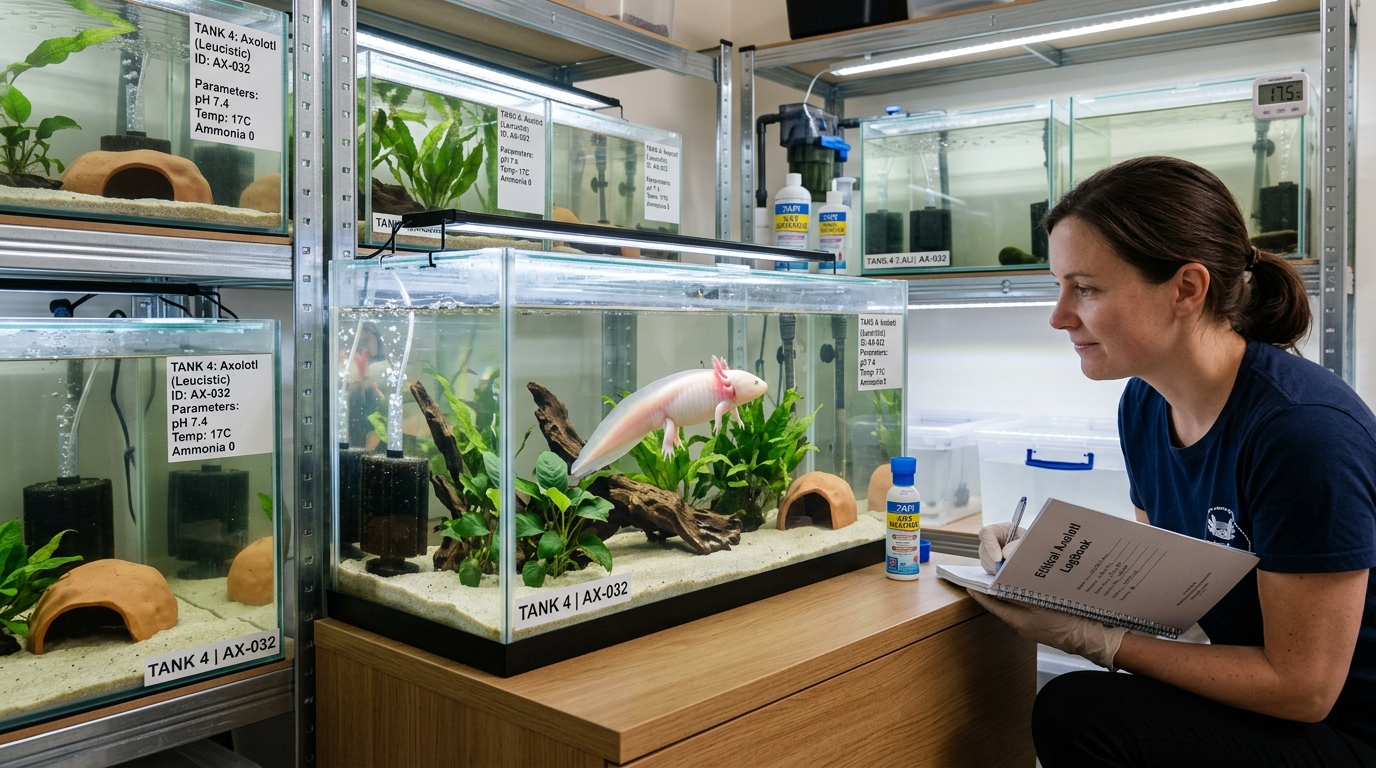
Source your axolotl from a captive-bred breeder who keeps lineage records, screens for disease, and answers your questions, never from the wild and rarely from a chain pet store. Every pet axolotl is captive-bred because the wild population is critically endangered, so responsible sourcing is about choosing a careful breeder and verifying legality before money changes hands.
Why is captive-bred the only responsible option?
The wild axolotl is critically endangered, surviving only in remnants of the Xochimilco canals near Mexico City, and collecting one is illegal under Mexican law. Every legitimate pet axolotl is captive-bred and many generations removed from the wild, so a responsibly sourced animal is, by definition, never a wild-caught one.
This is not a preference. It is the whole ethical baseline of the hobby. The species, Ambystoma mexicanum, is listed as Critically Endangered by the IUCN. The wild count is commonly put at the low hundreds to around a thousand adults (source: status per Conservation International). World trade is limited because the species sits on Appendix II of the global wildlife-trade treaty (source: listing per CITES). Its native home is just the still, lake-fed canals of Xochimilco and Chalco (source: range per San Diego Zoo Wildlife Alliance). The good news for keepers is that the pet population is a separate, large gene pool. The captive line descends from animals bred for over a century in labs and the hobby. So buying captive-bred is not a trade-off. It is the only legal and ethical route, and it has no downside. The animals are healthier, better documented, and used to tank life. A seller who offers a “wild” or “wild-caught” axolotl is either misinformed or breaking the law. Either way, it is a seller to avoid. From there, sourcing comes down to which captive breeder you trust, which the rest of this guide works through. The broader commitment behind owning one is covered in the axolotls as pets overview.
What separates a reputable breeder from the rest?
A reputable breeder keeps lineage records, houses animals in clean visible conditions, offers a live-arrival guarantee, ships responsibly, answers your questions willingly, and can speak to disease screening. Any one of these can be faked in isolation, but a breeder who clears all of them is almost always a safe source.
Vetting a breeder is a checklist, not a vibe. Run a candidate against these green flags before you put money down.
- Lineage records: they can tell you the parents, hatch date, and ideally a generation or two back. This matters because the captive gene pool is narrow, and tracked lineage is how careful breeders avoid the inbreeding that produces weak animals.
- Visible housing: they will show real photos or video of the actual breeding stock and grow-out tubs, not just stock images of the morph.
- Health guarantee: a live-arrival guarantee, and ideally a short health window, signals a breeder who stands behind their animals.
- Responsible shipping: overnight shipping with insulation and an appropriate cold or heat pack for the season, not an animal in a bare bag.
- Willingness to answer: they answer husbandry questions patiently and will discuss feeding history, water parameters, and age. A breeder who dodges questions is a breeder hiding something.
- Disease screening: this is the advanced ask. A strong answer to “do you screen for chytrid, the Bd fungus?” is “yes, we run periodic PCR swabs,” and an acceptable one is “we run a closed colony with strict quarantine.” A blank “what is chytrid?” is a real concern, because the fungus exists and can be devastating.
The single best filter is the questions test, because a breeder who happily talks lineage, feeding, and disease screening has usually done the work on all of it. Use the same eye for the animal itself; the choose a healthy axolotl guide covers what full gills and clear skin should look like.
What red flags should make you walk away?
Walk away from any seller who cannot provide lineage, prices an animal suspiciously low, ships in bare bags, sells into states where axolotls are banned, houses mixed sexes carelessly, shows no photos of real stock, or mass-produces undocumented animals at expos. Any single one of these is reason enough to stop.
Red flags are faster to spot than green ones, because a careless seller usually shows several at once. Here are the seven that disqualify a source outright.
| Red flag | Why it disqualifies the seller |
|---|---|
| No lineage information | unknown genetics mean a real risk of inbred, fragile animals |
| Suspiciously low price | a $15 to $20 animal is often poorly fed, raised in warm water, or sick |
| Ships in bare bags, no insulation | temperature swings in transit cause severe stress and toe loss |
| Sells into states where axolotls are banned | a seller ignoring the law on legality ignores it on welfare too |
| Mixed-sex housing without separation | leads to unplanned breeding and stressed, undersized animals |
| No photos of actual breeding stock | cannot verify the animals exist or are healthy |
| Mass-produced at expos, no documentation | volume sellers rarely track lineage or health |
The low-price flag deserves a second look, because it feels like the opposite of a warning. A “cheap” axolotl is frequently the most expensive one you will buy, since an animal raised in warm water on poor food often arrives carrying a health problem that costs far more to treat than the discount saved. From a rescue-intake perspective, the bargain-bin animal bought from an unvetted seller is the one I see surrendered most often, usually after a fungal infection or a failure to thrive that traced straight back to how it was raised. Buying the cheapest animal you can find is one of the most expensive beginner mistakes in the hobby.
Can you adopt or rescue instead of buying?
Yes, adoption and rehoming are responsible sourcing paths and often the most ethical of all. Axolotl rescues and keepers rehoming an animal they can no longer care for offer animals that need homes, frequently with honest health histories, and usually at lower cost than a breeder.
Rescue is underused because most buyers do not know it exists for axolotls, but it does. Dedicated axolotl rescues take in surrendered, abandoned, and sometimes seized animals. They nurse them back to health and adopt them out with care rules attached. Rehoming from another keeper, through local aquarium groups or hobby forums, is similar. You get an adult animal looking for a new tank, often with its existing setup. The trade-off is that a rescue or rehomed animal may come with unknown genetics or a past health issue. So you verify the same things you would with any source. Ask what is known about the animal’s age, history, and current health, see it eating if possible, and plan a full quarantine regardless. The upside is real. You give an existing animal a home rather than adding demand for more breeding, and you often get an honest account of any quirks. And if you ever end up on the other side of this, needing to rehome your own animal, a rescue or a vetted local keeper is the responsible exit. Never release one into the wild, which is illegal and lethal to a captive animal.
Are pet stores ever an acceptable source?
Most chain pet stores are poor axolotl sources, because they tend to house animals in warm water without lineage records, health screening, or trained staff. A pet store is acceptable only in the narrow case of a specialist aquatics shop that keeps axolotls cool, healthy, and can speak to where they came from.
The problem with the typical pet store is built in, not mean-spirited. Chain stores buy from large suppliers, so lineage is unknown. Staff are general helpers, so axolotl-specific care is hit or miss. And tanks are often kept at room temperature. That is too warm for a cool-water animal, and a common source of stress before you ever take it home. Add the lack of any health guarantee, and you have a source that stacks several breeder red flags at once. The exception is real, though. A specialist aquarium store, often independent, sometimes keeps axolotls properly, in cool water, with knowledgeable staff who can tell you the supplier and let you watch the animal feed. If a shop keeps its axolotls visibly cool and healthy, the staff answer husbandry questions well, and you can inspect the animal in person, it can be a reasonable source, with the bonus that you skip shipping stress entirely. Judge the individual shop by the same green flags you would use on a breeder, not by the sign over the door.
What should an axolotl actually cost?
A standard-morph axolotl typically costs about $30 to $80 from a breeder, common specialty morphs run higher, and genuinely rare morphs reach the hundreds or more. Price tracks rarity and breeding effort, so a fair price is one that reflects a well-raised animal, not the lowest number you can find.
Pricing is a quality signal when read correctly: too low is a warning, while a moderate price often means the animal was fed well and raised in cool, clean water. The table below gives typical market bands, which shift by region, season, and breeder, so treat them as planning ranges rather than fixed quotes.
| Morph | Typical price band (USD) | Notes |
|---|---|---|
| Wild type | $30 to $75 | most common; dark with speckles |
| Leucistic | $30 to $75 | pale body, dark eyes; widely available |
| Albino (white or golden) | $30 to $80 | golden often slightly higher |
| Melanoid | $40 to $100 | solid dark, no shine |
| Copper | $80 to $150 | less common |
| GFP variants | $50 to $150+ | glow trait adds a premium |
| Axanthic / lavender | $100 to $250 | uncommon |
| Piebald | $200 to $500+ | rare patterning |
| Mosaic / chimera | $300 to $1,000+ | very rare; not breedable to type |
Add roughly $40 to $60 for overnight shipping if the breeder is not local. The morph itself is mostly about looks, not care difficulty, so a wild-type and a leucistic need the same setup; the morph and color guide covers the visual differences. Remember that the purchase price is the smallest line in the budget, the full cost of ownership guide shows how the tank, cooling, and years of upkeep dwarf it, which is exactly why chasing the cheapest animal is a false economy.
How do you verify legality and quarantine before and after purchase?
Before you buy, confirm axolotls are legal where you live, since some places restrict or ban them; after the animal arrives, quarantine it in a separate tub for about 30 days before any contact with other animals. These two steps bracket the purchase and protect both your investment and your existing pets.
Legality first, because it is a zero-dollar step that can save the whole purchase. Axolotls are restricted or banned in some states and countries. The reason is usually that they are non-native, and officials worry about escaped animals in local waters. The rules vary enough that no general guide can give you a firm yes for your address. Some places are commonly reported as restricting axolotls, but laws change. So verify with your state or local wildlife agency rather than trusting a forum, and read the legal ownership rules for how to check properly. A reputable breeder already refuses to ship into banned areas, which is itself a green flag. Quarantine comes second, after arrival. Even an animal from an excellent breeder goes into a separate, cycled tub for about 30 days. The reason is that amphibian skin is permeable and soaks up germs and chemicals easily, which makes a watch-and-wait period genuinely protective (source: permeable skin per LafeberVet). During quarantine you watch feeding, gills, and skin daily. Confirm the animal is eating and stable before you move it to a main tank or add a tankmate. The quarantine guide walks through the setup. Here is the pre-purchase checklist in order:
1. Legal check: confirm axolotls are allowed where you live with your wildlife agency.
2. Breeder verification: lineage, photos of real stock, health guarantee, disease-screening answer.
3. Shipping method: overnight with insulation and a season-appropriate pack.
4. Tank readiness: a fully cycled tank or quarantine tub waiting before the animal ships.
5. Price sanity check: a fair band, not a too-good-to-be-true bargain.
6. Vet identified: an exotic-animal clinic located before you need one.
For any health concern that appears during or after quarantine, consult an exotic-animal veterinarian rather than treating blind, since the wrong medication can harm a permeable-skinned animal. Once the animal clears quarantine and joins its permanent tank, the day-to-day husbandry that keeps it healthy lives in the axolotl care guide.
Frequently asked questions
Is it legal to buy a wild-caught axolotl?
No, and you will not find a legitimate one anyway. Collecting axolotls from the wild is illegal under Mexican law, and the wild population is critically endangered, so there is no legal wild trade. Every pet axolotl sold responsibly is captive-bred and many generations removed from wild animals. A seller advertising a “wild-caught” axolotl is misinformed or breaking the law, and either way is a source to avoid completely.
How can I tell if a breeder is reputable?
Ask questions and watch how they answer. A reputable breeder readily shares lineage, hatch dates, feeding history, and real photos of their breeding stock, offers a live-arrival guarantee, ships responsibly, and can speak to disease screening like chytrid. A breeder who dodges questions, shows no photos of actual animals, or prices suspiciously low has failed the test. The willingness to talk openly about genetics and health is the strongest single signal of a careful breeder.
Should I buy from a pet store or a breeder?
A breeder is almost always the better choice, because you get lineage records, a health guarantee, and an animal raised in proper cool-water conditions. Most chain pet stores keep axolotls too warm, without lineage or screening, which makes them a poor source. The exception is a specialist aquatics shop that keeps its axolotls cool and healthy and whose staff can answer husbandry questions, which can be a reasonable in-person option that skips shipping stress.
What is a fair price for a common axolotl morph?
A common morph like wild type, leucistic, or albino typically costs about $30 to $80 from a breeder, plus roughly $40 to $60 for overnight shipping if needed. Prices below that range often signal a poorly raised or unhealthy animal, while rare morphs run into the hundreds for genetics and scarcity, not better care. A fair price reflects a well-fed animal raised in cool, clean water, which is cheaper in the long run than a bargain that arrives sick.
Do I need to quarantine an axolotl from a reputable breeder?
Yes, quarantine every new axolotl regardless of source, for about 30 days in a separate cycled tub. Even a healthy-looking animal from an excellent breeder can carry something that surfaces under the stress of shipping and a new tank, and amphibian skin absorbs pathogens readily. Quarantine lets you confirm the animal is eating and stable, and it protects any existing animals from a problem you cannot yet see. Skipping it to save effort risks your whole collection.
What should I do if I can no longer keep my axolotl?
Rehome it responsibly, never release it. Contact an axolotl rescue, post in local aquarium or hobby groups, or return it to the breeder if they offer that, and be honest about the animal’s history and any health issues. Releasing a captive axolotl into the wild is illegal in most places and a death sentence for the animal, which cannot survive outside a managed tank. A responsible exit protects both the animal and the local ecosystem.
Related guides
By the ExoPetGuides editorial team (AI-assisted drafting; human-reviewed), reviewed by an exotic-animal veterinarian.
Updated 2026-06-07.
Primary sources: IUCN Red List, CITES, San Diego Zoo Wildlife Alliance, LafeberVet amphibian care references.
Disclaimer: This content is for educational purposes only and is not a substitute for professional veterinary advice. Always consult a qualified veterinarian, ideally an exotic-animal specialist, for any health concern about your pet. Care recommendations may vary based on species, individual animal, and local regulations.
