

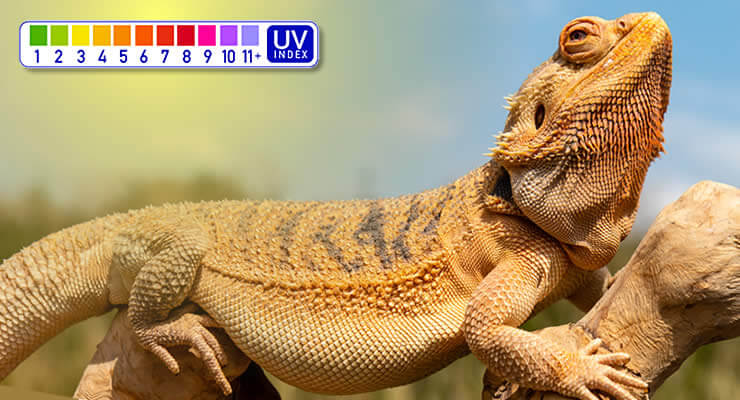
Bearded Dragons are Ferguson Zone 3
What Ferguson Zone are bearded dragons? Originating from Australia, Bearded Dragons thermoregulate as open sun baskers exposing themselves to a UV Index of 2.9 – 7.4 during the day.That places them at the upper end of Ferguson Zone 3, with some individuals and basking behaviours occasionally edging into Zone 4 during the hottest part of the day. Replicating that pattern within the enclosure with a defined basking spot and proper lighting helps support natural behaviours and lowers the risk of health issues like metabolic bone disease.
What are Ferguson Zones?
We know that recreating the ultraviolet part of sunlight is very important to reptile health and wellbeing. How do we measure it, with what and how much do we need for our animals?
We need a device that measures the UV range we are looking for and the Solarmeter 6.5 does just that, measuring from 280-400nm. This handheld device has been developed to measure the strength of UV from the sun to help people protect themselves from sunburn, however, this spectrum is very close to the D3 synthesis range, making it suitable for our use. The scale starts at 0 and goes upwards. This has been used in weather forecasting, when sunny, and is expressed as the UV Index (UVI). The higher the UVI the greater the power of the sun, which changes over the course of the day reaching its peak at midday.
How to Use the Index
As reptile keepers we can use this index to measure wavelengths that let our reptiles produce their own vitamin D3. As our pet reptiles originated from different countries, with many different habitats, they have morphologically evolved to take advantage of environmental niches for the optimal benefit to their species. This means that two different types of reptiles, even from the same area, may still have completely different UV requirements.
To help make sense of this, a renowned herpetologist, Dr. Gary Ferguson measured different reptile’s daily basking sites and exposure times which gave him a good indication to their natural UV requirements. These species were divided up into four different sun exposure groups, which are now referred to as Ferguson zones. Each zone was allocated a range of figures, calculated from the readings, that were taken from the animals basking UVI. Other researchers have added more data to this study to help create a list of animals that fit into these four zones.
Ferguson Zone 1

Crepuscular or Shade Dweller
Zone range UVI 0 – 0.7 (Maximum UVI: 0.6 – 1.4 in basking zone)
Examples: crested geckos, leopard geckos, royal pythons, tokay geckos, Burmese pythons, green tree pythons, milk snakes, reticulated pythons.
Intermediate 1-2
Examples: Fiji banded iguanas, corn snakes, carpet pythons.
Ferguson Zone 2

Partial Sun or Occasional Basker
Zone range UVI 0.7 – 1.0 (Maximum UVI: 1.1 – 3.0 in basking zone)
Examples: Australian water dragons, emerald tree monitors, green anoles, monkey-tailed skinks, pygmy chameleons, ornate box turtles, red foot tortoises, boa constrictors, red-tailed ratsnakes, garter snakes, western hognose snakes.
Intermediate 2-3
Examples: blue-tongued skink, Chinese water dragon, panther chameleon, common musk turtle.
Ferguson Zone 3

Open or Partial Sun Basker
Zone range UVI 1.0 – 2.6 (Maximum UVI: 2.9 – 7.4 in basking zone)
Examples: black and white tegu, frilled lizard, Standing’s day gecko, Yemen chameleon, Indian star tortoise, leopard tortoise, spotted turtle, diamond python.
Intermediate 3-4
Examples: bearded dragon, bosc monitor, green iguana, painted turtle, red-eared slider, African spur-thighed tortoise.
Ferguson Zone 4

Mid-day Sun Basker
Zone range UVI 2.6 – 3.5 (Maximum UVI: 4.5 – 9.5 in basking zone)
Examples: chuckwalla, uromastyx, rhinoceros iguana, Texas horned lizard.
Quick note on using Ferguson Zones:
Ferguson Zones are a guide for setting safe UVB lighting based on UVI readings at the animal’s basking spot, they’re not a “one-size-fits-all” rule. Aim to create a gradient so your reptile can self-regulate exposure, just like it would under natural sunlight in the wild, and always leave a clear route into shade. Use a suitable UVB bulb for the species, mount it correctly, and pair UVB with appropriate heat and a consistent day/night cycle so behaviour and wellbeing stay on track.
Husbandry still matters. UVB is just one piece of the puzzle – diet, hydration, and stress levels all influence long-term well being, even for closely related species with similar zone ranges.
Need Help Understanding Ferguson Zones?
Need help understanding Ferguson Zones or choosing the right UVB setup for your specific reptile? We can help you match UVB exposure to natural behaviours, so your basking area support vitamin D3 production, healthy body temperature regulation, and overall wellbeing, especially for arid species like the eastern bearded dragon. For more guidance on bearded dragons, check out our Bearded Dragon Care Sheet.
Email us at sales@reptilecentre.com. For product-specific queries about bulbs and proper lighting, you can also contact Reptile Systems directly at support@aquariumsystems.uk.
